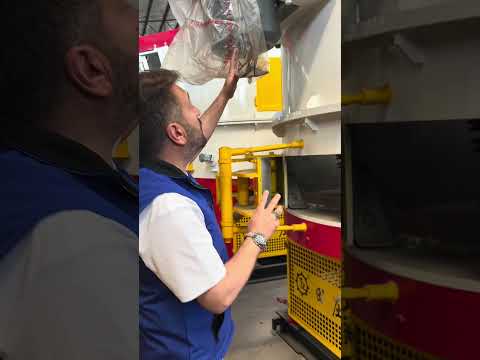
A sand cooler takes green sand coming back from shakeout at 80–120 °C, sometimes hotter, and brings it below 40–45 °C before the mixer. Hot sand loses water fast in the mixer, the bentonite does not develop properly, compactability drifts, and you start to see sticking, sand drops and dimensional problems in the mould. On lines turning over a few dozen tonnes of green sand an hour, a cooler is standard equipment.
Why hot sand is a problem
Part of the water added in the mixer flashes off straight away. Moisture control stops holding and compactability moves from batch to batch. The bentonite cannot hold water, so the sand comes out dry and friable. Hot sand sticks to patterns and causes condensation on cold patterns and cores. Steam condenses in hoppers and on belts, the sand lumps and bridges in the hopper. All of this gets worse in summer.
How it works
Most sand coolers rely on evaporative cooling. Water is sprayed onto the sand and air passing through carries the steam away. A rough rule: every 1% of water evaporated cools the sand by about 25–27 °C (latent heat of water 2,260 kJ/kg, specific heat of sand around 0.84 kJ/kg·K). So bringing sand from 110 °C to 40 °C means evaporating water equal to about 2.5–3% of the sand weight, on top of the water needed for moulding moisture.
The exhaust air is wet and dusty. If the dust collector is not chosen for wet air, the bags blind with mud; if the duct is not insulated, it condenses inside.
Types of sand cooler
Fluid bed vibrating cooler: air is blown up through a perforated deck while vibration moves the sand forward. Low, compact and continuous. The main maintenance item is the perforated plate blocking up.
Rotary drum cooler: sand spends a long time in a turning drum with air flowing against it. Comfortable at high capacity, and on some lines combined with the shakeout drum. It needs length.
Mixer-type cooler: a fan pulls air through an intensive mixer body. It cools, pre-moistens and homogenizes the sand at the same time, and saves space on mid-size lines.
Surge hopper: not a cooler on its own. A big hopper lets the sand rest and lose some heat but cannot keep up at high flow. Behind a cooler it works well as a buffer.
Typical match
- 10–30 t/h — Common type: Mixer-type cooler or small fluid bed
- 30–100 t/h — Common type: Fluid bed or mixer-type cooler
- Above 100 t/h — Common type: Rotary drum or large fluid bed
Treat this as a first cut. Floor space, the existing line and the sand-to-metal ratio can change the answer.
What to look at when choosing
- Sand flow: size for the peak hourly sand flow, not the line average.
- Inlet temperature: the lower the sand-to-metal ratio, the hotter the sand. For green sand it is typically between 5:1 and 10:1.
- Target outlet: temperature (40–45 °C, or 5–10 °C above ambient) and moisture.
- Measurement and control: inlet temperature and moisture sensors with automatic water dosing. Without them the cooler either wets the sand or does not cool it enough.
- Air and dust: fan capacity, a filter suited to wet air, insulated ducting.
- Space and height: drums are long, fluid beds are low. Fitting into the existing building often decides it.
- Water quality: hard water blocks spray nozzles; soften it if needed.
Checklist for a used sand cooler
- Wear: thickness of liners and wear plates in contact with sand.
- Fluid bed perforated plate: blocked, holed, or already replaced?
- Drum: tyres, rollers, drive gear and internal flights.
- Sensors and water valves: working, and spares available?
- Fan and motor: bearings, blade wear, balance.
- Control software: does the water dosing program come with it?
- Capacity: does the rated flow cover your peak sand flow?
- Filter: can your existing dust collector handle the wet exhaust air?
FAQ
Can I run without a sand cooler? On small, slow lines a large surge hopper and a high sand-to-metal ratio can get you by. As flow goes up, and in summer, sand quality suffers.
How cool should the sand be? Sand entering the mixer should not be above 40–45 °C. Better still is 5–10 °C above ambient.
How much water does a cooler use? Cooling sand from 110 °C to 40 °C evaporates water equal to about 2.5–3% of the sand flow. On a 50 t/h line that is 1.3–1.5 tonnes of water an hour.
Can a mixer-type cooler replace the moulding sand mixer? No. The cooler cools and pre-moistens; bentonite, coal dust and final moisture are still set in the moulding sand mixer.
Related listings and guides
Used: USED-1879 Künkel-Wagner ASK60 sand cooler, USED-1781 Eirich RV15 sand plant, USED-1943 ELM-based automatic sand preparation and distribution system, USED-1989 Eirich RV23 sand mixer, USED-1980 ÇMS KM-1500 sand mixer. Related guides: How to choose a sand mixer, Sand conveying in foundries, Foundry shakeout grids, Foundry dust collectors, Moulding sand testing laboratory.
How ZENES helps
We size the sand cooler as part of the sand plant, together with the mixer, hoppers and dust collector. For new plants we collect quotes from makers on the same scope; used coolers we inspect on site, dismantle and ship. Send your hourly sand flow, sand-to-metal ratio and the sand temperature at the mixer in summer, and we will work out the cooler type and size.