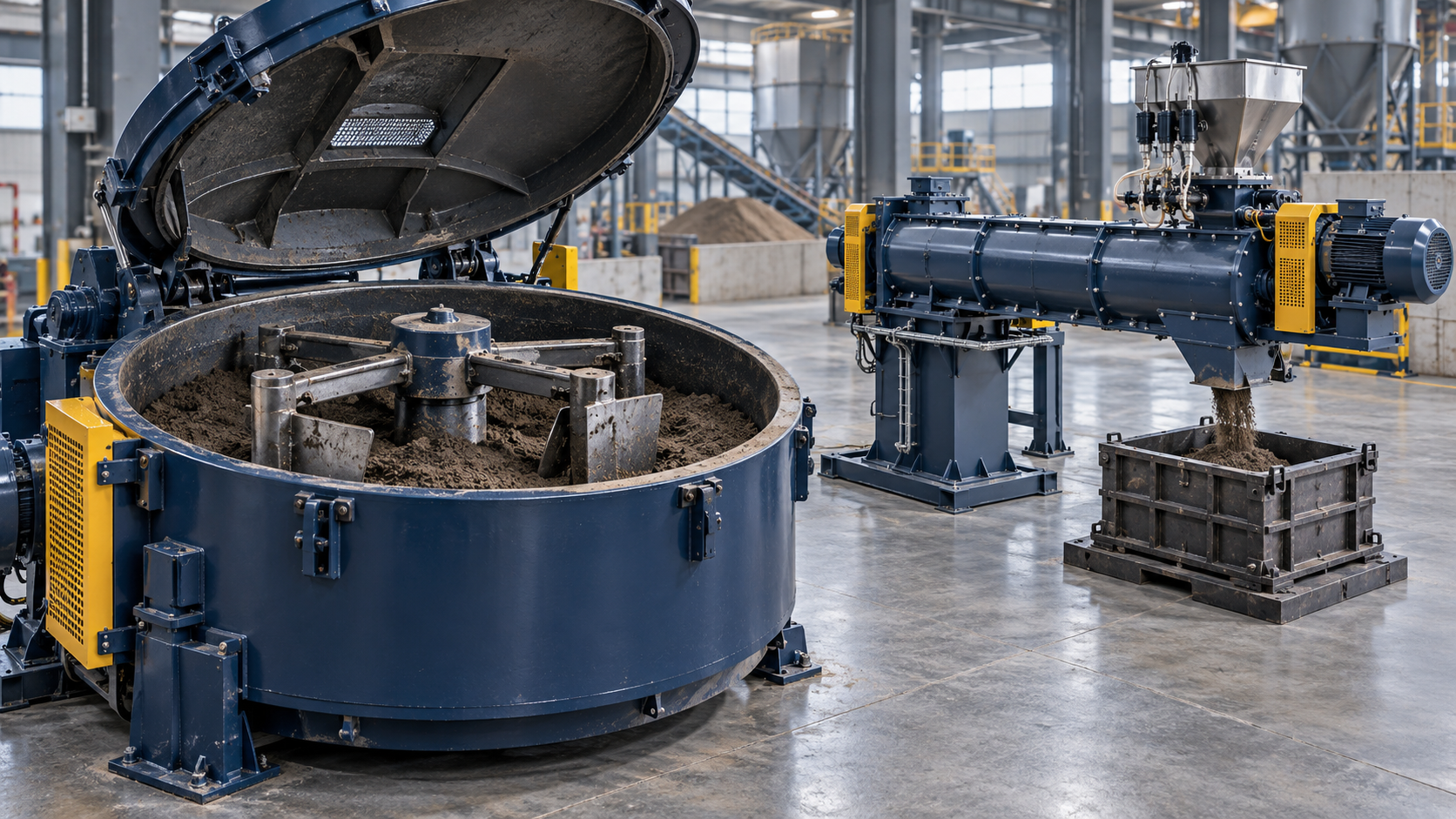
Selecting a sand mixer requires more than comparing vessel volume or motor power. First establish which sand will be prepared, how much the moulding operation needs and how the required sand quality will be verified. Comparing quotations under the same operating conditions is essential to selecting suitable equipment.
1. Identify the sand and binder system first
Green sand preparation requires uniform mixing of sand, bentonite, water and additives. Assess the mixing process against the compactability, strength and permeability required for moulding.
For resin-bonded sand, specify the binder system separately. Batch mixers are not restricted to green sand; batch machines are also available for resin-bonded applications. Assess operating mode and chemical-system compatibility as separate requirements.
2. Distinguish litres, kilograms and tonnes per hour
Litres express volume, kilograms express batch mass, and tonnes per hour express throughput. Ask whether the quoted volume is the total vessel volume or its usable working volume. Converting volume into mass requires the bulk density of the sand concerned.
A simplified calculation for a batch mixer is:
Theoretical capacity (tonnes/hour) = batch mass (kg) × 3,600 ÷ total cycle time (seconds) ÷ 1,000
For example, a 500 kg batch and a 120-second total cycle give a theoretical capacity of 15 tonnes/hour. This is an illustrative calculation, not a machine specification or production guarantee. Include charging, mixing and discharge in the cycle; assess waiting periods and downtime separately.
3. Calculate demand from the moulding operation
As a starting point, multiply sand consumption per mould by the target number of moulds per hour. For example, 80 kg/mould × 100 moulds/hour equals a sand demand of 8 tonnes/hour. These figures illustrate the method only.
Where several stations consume sand, examine simultaneous demand and short-term peaks. Do not base the investment solely on monthly casting tonnage; document the plant’s sand flow and operating pattern.
4. Define measurable sand-quality acceptance criteria
For green sand, establish how moisture, compactability and strength will be checked. Recipe and batch records help track changes during production.
For resin-bonded sand, ask how sand flow and chemical dosing will be controlled and calibrated. Calibration access is a practical feature to assess during mixer selection. Do not assume every supplier offers the same control arrangement.
5. Assess the mixer as part of the complete sand system
Sand preparation includes return-sand handling, pretreatment, storage, mixing and delivery to the moulding line. The mixer is one component in this chain.
Before requesting quotations, provide feed and discharge elevations, available space and maintenance-access requirements. For continuous mixers, reach, mobility and variable-height arrangements can be assessed against the proposed layout.
6. Compare new and used options using the same checklist
List wear parts, drives, dosing equipment, automation, documentation and service scope separately when comparing prices. For used equipment, also request a condition report, details of missing components and refurbishment requirements.
Define the test sand, target throughput, quality measurements and acceptance-test conditions at quotation stage. Clarify the conditions under which the stated catalogue capacity applies.
ZENES evaluates new and used mixers, manufacturer selection and complete sand preparation requirements against project objectives. The relevant quotation defines the scope of project management, procurement, installation, commissioning and after-sales services.
Let us assess your project
Send ZENES your sand type, sand consumption per mould, target moulds per hour and existing layout. Let us assess your mixer and sand-system requirements together.
Technical references (28 September 2026)
These sources are technical references, not statements of representation or available stock.
EIRICH — Green sand preparation: https://www.eirich.com/en/industries/foundry-sand/preparation-with-air-cooling
EIRICH — Quality assurance: https://www.eirich.com/en/industries/foundry-sand/quality-assurance
EIRICH — Sand preparation systems: https://www.eirich.com/en/industries/foundry-sand/system-for-molding-sand-preparation
Sinto — Batch sand mixers: https://sintoamerica.com/product/batch-sand-mixers/
Sinto — Continuous mixers: https://sintoamerica.com/product/tom-series-mixers/
Omega Sinto — Sand mixers: https://www.ofml.net/omega-foundry-equipment/sand-mixers