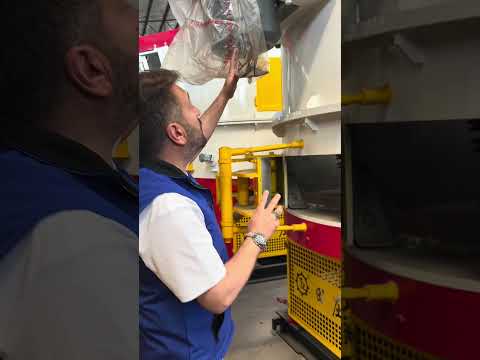
By Kadir Yılmaz, founder of ZENES Makina Mühendislik (20+ years in the foundry industry)
What is a continuous resin sand mixer and when do you need one?
A continuous mixer (often called a continuous resin blender) runs sand through a trough where high-speed blades coat it with resin and catalyst, then drops it straight into the flask or core box. It is the standard machine for no-bake systems: furan, alkaline phenolic ester (Alphaset type) and phenolic urethane. Because mixed sand only stays workable for minutes, it has to be made at the point of use, as it is needed. That is what a continuous mixer does.
Continuous vs batch
A batch mixer makes a set quantity and discharges it. It works for green sand and small resin jobs. On a large mould, the first sand starts to cure before the last batch arrives. In a continuous mixer sand passes through the trough in seconds, so the mould fills in one go with sand of the same age. For general mixer selection see our sand mixer guide; this page covers continuous no-bake mixers only.
Types
- Stationary: for cores and small moulds, usually 3–10 t/h. The box comes to the mixer.
- Single-arm swivel: the most common. Arm 3–8 m, slewing 180–270°, mounted under the sand silo.
- Double-arm (articulated): the arm folds and covers a wider area; used in large-mould shops.
- Travelling: rides on rails along a long moulding floor.
Typical figures
| Item | Typical range |
|---|---|
| Throughput | 3–60 t/h (10, 20 and 30 t/h are common) |
| Arm reach | 3–8 m |
| Blade speed | 400–900 rpm (high-speed type) |
| Furan resin | 0.8–1.2% of sand; acid catalyst 30–50% of resin |
| Alkaline phenolic resin | 1.2–1.8% of sand; ester 20–25% of resin |
| Mixer drive | 7.5–37 kW depending on throughput |
| Best sand temperature | 20–30 °C |
Addition rates depend on the resin supplier, sand grade and the share of reclaimed sand.
How to size it
Throughput: size to the fill time of your largest mould, not the hourly average. To fill a 6-tonne mould in 15 minutes you need at least 25–30 t/h.
Reach: draw the moulding area and mark the farthest corner the sand must reach. Wherever the arm stops, sand gets moved by hand, and sand quality drops.
Binder system: furan and alkaline phenolic can run on the same mixer, but check pump materials, hoses and seals. If you might switch systems later, plan the dosing line for it now.
Dosing pumps: gear or peristaltic pumps with flow meters and calibration valves. Resin and catalyst must be interlocked with sand flow: no sand, no resin.
Cleaning: the trough cover should open quickly. Furan sand cures in the trough, and a mixer that missed its end-of-shift clean will not start the next morning.
Sand temperature: below 10 °C sand cures slowly; above 35 °C bench life shortens. A sand heater/cooler ahead of the silo keeps mixer settings stable. In hot climates this is worth budgeting from day one.
Notes from the floor
Resin consumption depends mostly on calibration. Where pumps are not calibrated weekly we often find 10–15% more resin going in than intended. Blade wear causes the same problem: worn blades mix poorly, the operator turns up the resin, and both cost and gas defects rise. With reclaimed sand, track loss on ignition (LOI) and cut resin as it climbs.
Used continuous mixer: checklist
- Trough liner and blades: measure thickness, replace as a set if needed.
- Slewing bearing and gearboxes: play and noise.
- Resin and catalyst pumps, flow meters, check valves: run a calibration test.
- Sand gate and silo outlet.
- Control panel and PLC: does recipe memory work?
- Cured sand build-up in the trough tells you how it was maintained.
- Are the silo and sand heater/cooler included?
FAQ
Can a furan mixer run alkaline phenolic?
Usually yes, after checking pump materials, seals and dosing range. Sometimes the pumps are changed.
How often should it be calibrated?
Resin and catalyst weekly, sand flow monthly, and again whenever the resin batch changes.
Should the mixer be planned with reclamation?
Yes. Reclaimed sand ratio, sand temperature and silo size set the mixer's operating conditions.
Is an oversized mixer a problem?
A very large mixer cannot dose small cores accurately. If core and mould work are separate, two mixers are the better answer.
Related
- Listing: USED-1999 TES-SAN Alphaset / CO2 resin sand mixer, single arm
- Listing: USED-1930 Omega Sinto Spartan III sand reclamation
- Product: Tianzhuang continuous mixer
- Guides: How to choose a sand mixer, Sand conveying in foundries
How ZENES helps
Send us mould sizes and daily sand demand and we will work out throughput and arm reach. For new mixers we compare suppliers on the same scope; for used mixers we run the calibration test on site and report back. We install the mixer together with the silo, reclamation and sand conveying as one project.