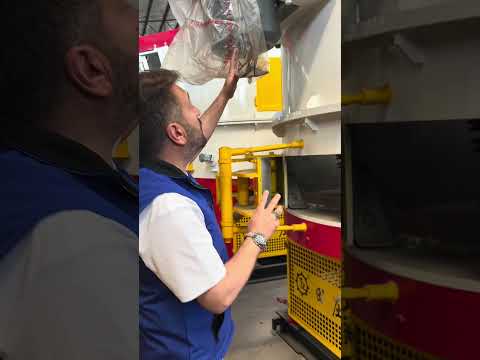
Sand reclamation breaks down used no-bake moulds, scrubs the resin coating off the grains, removes the dust, cools the sand and sends it back to the mixer. With furan sand, a well-built mechanical system returns 90-95% of the sand, so new sand drops to 5-10% of the mix. Alkaline phenolic and silicate sands reclaim less well mechanically, which is where thermal or hybrid systems come in.
The reclamation plant is the least visible part of a foundry, yet it pays back in plain numbers: new sand, freight and waste sand disposal all show up on the monthly bill. This guide covers what the plant is made of, how to size it, and where to look on a used system.
What a mechanical reclamation line consists of
- Shakeout grid: a vibrating grid breaks the mould and separates the casting.
- Lump breaker: crushes sand lumps down to near grain size.
- Magnetic separator: pulls out metal, nails and wire.
- Attrition unit: rubs grains against each other or against a rotor to strip the resin shell. This is where the real reclamation happens.
- Dedusting and classification: an air stream separates fines and broken grains and sends them to the filter.
- Sand cooler: brings the sand to mixer temperature, typically 20-30 °C. With furan, sand temperature directly changes strip time.
- Silos and pneumatic conveying: feed the reclaimed sand to the mixer.
Attrition and cooling are the two expensive items. When comparing offers, check that both are rated at the same throughput as the line. A plant sold as 10 t/h with a cooler that manages 6 t/h in summer is a 6 t/h plant.
When thermal reclamation makes sense
A thermal unit heats the sand to 650-800 °C, burns off the organic binder, then cools it. The result is close to new sand.
Thermal is usually on the table when:
- The foundry runs alkaline phenolic sand: mechanical reuse typically tops out around 70-80%, and residual potassium degrades the sand.
- Core sand (cold box, shell) makes up a large share of the system sand.
- Waste sand disposal is expensive or restricted.
- Reclaimed sand is wanted for core making.
Capital cost and gas consumption are clearly higher than for a mechanical line. Ask suppliers to state gas use in Nm³ per tonne, and at what sand outlet temperature it was measured.
How to size the plant
No-bake sand-to-metal ratios typically run between 3:1 and 6:1. The arithmetic:
- 40 t of liquid metal per day at 4:1 means 160 t of sand per day.
- Over two shifts (16 h), that is 10 t/h.
- Add 15-20% margin and choose a 12 t/h line.
Small and mid-size foundries typically run 3-20 t/h plants. Check the mixer against the same figure; our continuous resin sand mixer guide covers that side.
Testing reclaimed sand
- Loss on ignition (LOI) — What it tells you: Binder left on the grains; Typical target (furan): Below 3%; a good line runs 1.5-2.5%
- Grain distribution (AFS) — What it tells you: Whether grains are breaking down; Typical target (furan): Close to new sand, stable
- Fines content — What it tells you: Whether dedusting is working; Typical target (furan): Below 0.5%
- Sand temperature — What it tells you: Whether the cooler keeps up; Typical target (furan): 20-30 °C
- Moisture — What it tells you: Drying problems; Typical target (furan): Below 0.2%
Rising LOI means either the attrition is not doing enough or the new sand addition is too low. Logging these numbers weekly catches sand-related gas defects early.
Buying a used reclamation plant
Reclamation lines come on the market regularly from European foundries that close or change their sand system. Check:
- Attrition rotor and liner plates: wear allowance and spares
- Screens, bearings, vibrator motors
- Scale and leaks in the sand cooler water tubes
- Dust collector: bag condition, fan airflow, sized for the line throughput
- Wear in the pneumatic transporter vessel and pipe bends
- Are silos and level sensors part of the sale?
- Control panel, PLC software, wiring diagrams
- Which binder the plant last ran on (furan, alkaline phenolic, silicate)
The last point matters. A line that ran alkaline phenolic can be converted to furan, but the sand and the line need cleaning first.
FAQ
How fast does sand reclamation pay for itself? It depends on sand price, freight and disposal cost. Multiply daily sand use by the cost of new sand plus disposal per tonne, subtract the plant's power and maintenance cost, and you have the monthly saving.
Does a green sand plant need reclamation? Green sand recirculates on its own. Where a lot of core sand ends up in the system, the surplus can be recovered thermally.
Can reclaimed sand be used for cores? Mechanically reclaimed furan sand usually goes back into moulds. For cores, new sand or thermally reclaimed sand is preferred.
What does the building need? Height for the silos and outdoor space for the dust collector. Lay the line out on the shortest path between shakeout and mixer.
Related listings and guides
- USED-1930 Omega Sinto Spartan III sand reclamation and preparation system
- USED-1894 Omega Sinto USR reclamation and pneumatic conveying system, 2024, unused
- USED-1955 FTL shakeout and sand separation system
- USED-1999 TES-SAN Alphaset / CO2 resin sand mixer
- Guides: Continuous resin sand mixer, Foundry sand conveying, Choosing a sand mixer, vibration table guide
How ZENES helps
ZENES supplies mechanical and thermal reclamation lines for furan and alkaline phenolic sand, new and used. Send us your daily poured tonnage, sand-to-metal ratio and binder type, and we size the reclamation line together with the mixer and conveying. On used plants we do the on-site inspection, dismantling and reinstallation ourselves.