
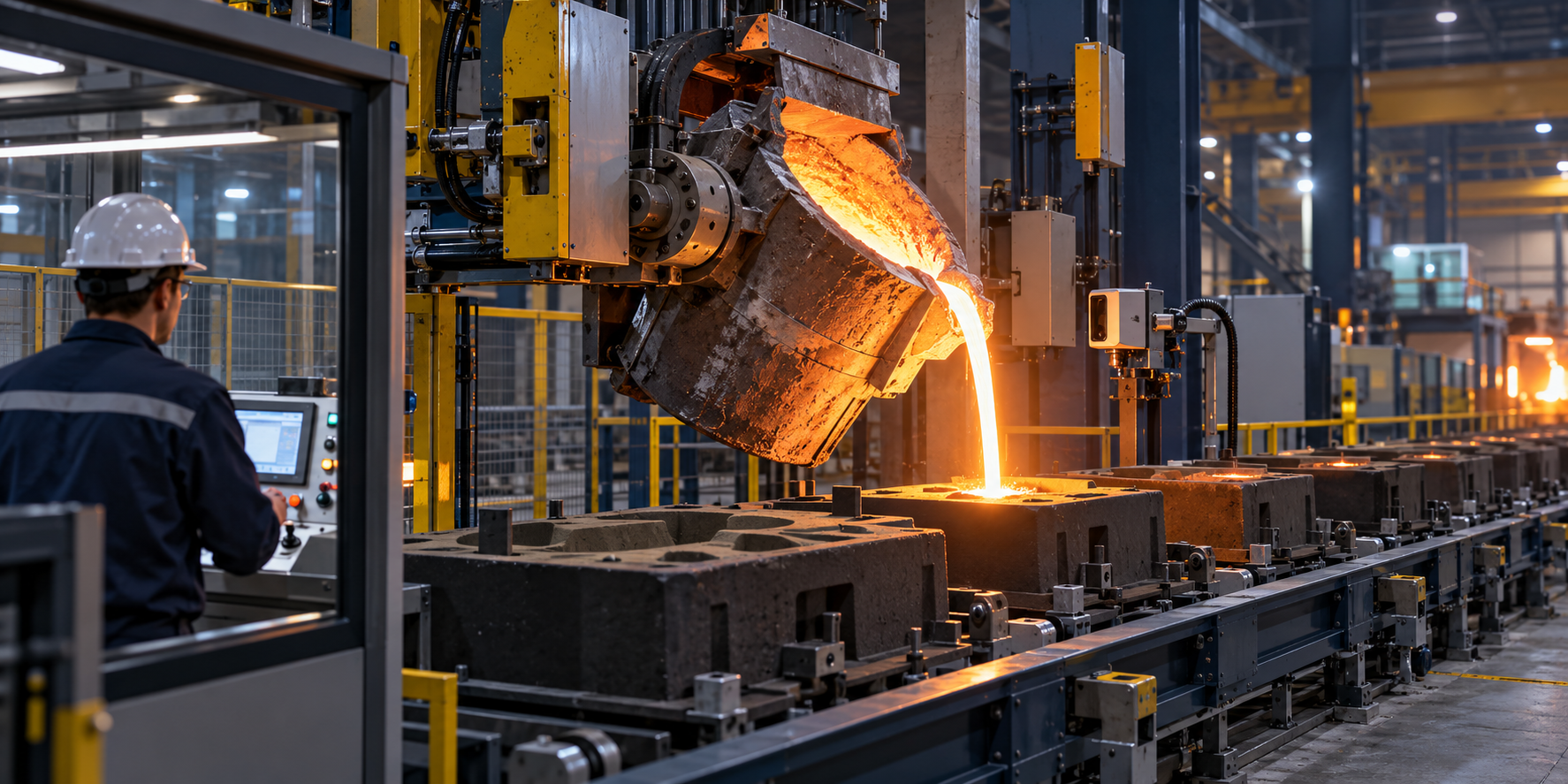
An automatic pouring system is more than a machine that transfers molten metal into a mould. It must work with melting and holding capacity, mould transport, pouring recipes and production monitoring. Select against the actual line cycle, not ladle capacity alone.
1. Define the casting programme
List metal and alloy grades, metal weight per mould, the lightest and heaviest pour, gating and cup design, temperature range, inoculation requirements and daily pattern changes. The unit must control flow throughout this production range.
2. Measure the actual moulding-line cycle
Catalogue moulds-per-hour speed is insufficient. Place core setting, mould arrival, cup detection, pouring, preparation for the next mould and planned stoppages on one timeline. Transferring mould positions and recipes to the pouring unit can reduce manual adjustments after pattern changes.
3. Compare pouring methods against the production scenario
- Unheated bottom-pouring ladle: Consider for flexible production and frequent alloy changes.
- Heated holding or pressure-pour system: Consider when temperature-controlled metal is held beside the line and alloy changes are limited.
- Servo-controlled tilting unit: Assess pour weights, cycle, ladle exchange and plant layout.
Compare heating, refractory, cleaning, energy, metal losses and maintenance alongside capital cost. Inductotherm describes pressure-pour equipment particularly for high-production plants with relatively few alloy changes.
4. Calculate metal logistics
Melting furnaces, transfer ladles and pouring equipment must sustain one metal balance across the shift. Document actual hourly demand, replenishment intervals, stops during ladle exchange, temperature loss and the contingency for an unavailable furnace.
5. Assess cup detection and level feedback
Cameras or lasers can locate the pouring cup and provide metal-level feedback. Assess protection against dust, smoke and heat; sensor cooling; detection of small cups; and safe response to a sensor fault. A manufacturer's 3D line-laser solution is described for bottom-pouring systems on both horizontal and vertical moulding lines.
6. Test the flow profile as well as weight
The same quantity of metal can enter the mould at different initial and filling rates. Compare time, flow rate, weighing, optical feedback, servo movement and part-specific recipes. Acceptance trials should measure repeatable pouring of selected real castings, not just achievement of a target weight.
7. Integrate inoculation, safety and traceability
Where inoculation is needed, synchronise dosage with metal flow and define responses to missing doses and blockage. Assess operator access, molten-metal routes, guarding, emergency stops, overflow, extraction and maintenance space for the plant. Per-mould records may include recipe, time, target and actual metal quantity, temperature, inoculation and alarms.
8. Write acceptance criteria around production
Factory and site acceptance should test cycle time, weight repeatability, cup detection, pattern and recipe changes, metal replenishment, alarms, safety functions, PLC data exchange and training using agreed castings. Evaluate new and used options against the same production objective and plant infrastructure.
Discuss your project with ZENES: Share the moulding-line type, mould dimensions, target mould rate, metal weight per mould, alloy range and available melting capacity. We can assess the appropriate automatic pouring method and integration within the agreed project scope.
Technical sources
DISA — process integration · Pour-tech — sensor-controlled pouring · Inductotherm — pressure-pour systems · Sinto — pouring control