
A FIELD PERSPECTIVE ON TÜRKİYE’S FOUNDRY NETWORK
Understanding Türkiye’s foundry industry requires looking beyond its largest factories. Foundries operating across different cities form a wider industrial network through their production knowledge, equipment and customer relationships.
The size of this network was one of the topics discussed during our live broadcast with Cem Arslan.
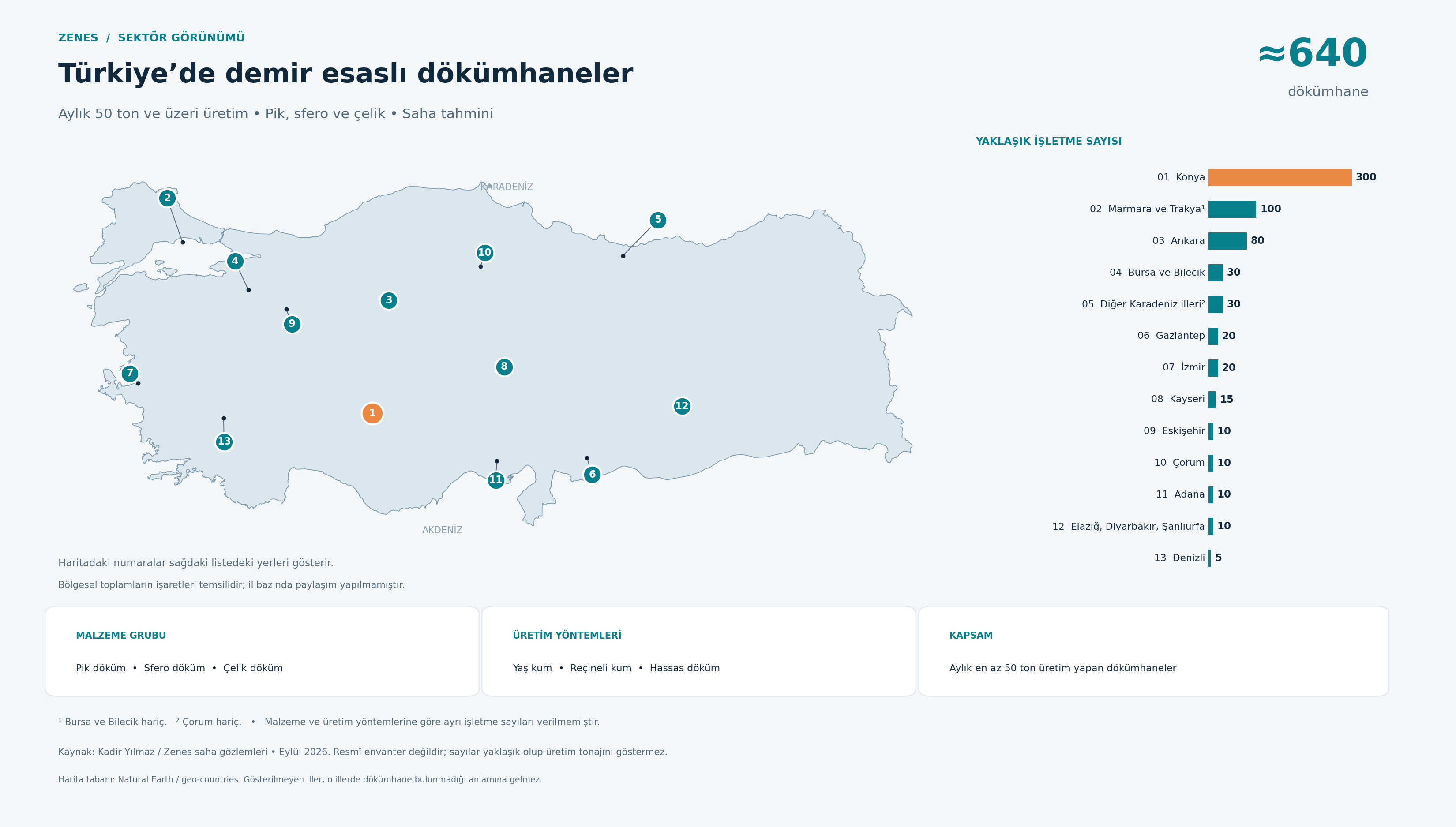
Drawing on ZENES’s field observations, factory visits and industry discussions, our preliminary assessment estimates a network of approximately 640 facilities within the defined scope.
This figure is not an official census or a verified facility-by-facility inventory. It should not be interpreted as the total number of all casting businesses in Türkiye. It is a preliminary estimate open to further verification and contributions from the industry.
WHICH FACILITIES ARE INCLUDED?
The assessment focuses on grey iron, ductile iron and steel foundries considered to operate at a production scale of 50 tonnes per month or more.
The process categories considered are green sand casting, resin-bonded sand casting and investment casting. Metal type and production process are separate classifications. A facility may use more than one metal or process and should not be counted again under each category.
Aluminium and other non-ferrous foundries, together with facilities below the stated production threshold, are outside the scope of this approximate total.
SELECTED CITY ESTIMATES
Our preliminary field assessment uses estimates of approximately 300 facilities for Konya and 80 for Ankara. Selected additional estimates are around 20 each for İzmir and Gaziantep, 15 for Kayseri, and 10 each for Eskişehir and Çorum.
These are selected examples rather than the complete distribution. They are not official city statistics and remain subject to verification. Regional groups and city records must be reconciled to clarify coverage and eliminate duplicate entries.
WHAT DOES THE NUMBER OF FACILITIES TELL US?
Facility counts provide an initial indication of how widely the production network is distributed. They do not, by themselves, establish total output, technological capability or competitiveness.
Two regions with the same number of facilities may have very different plant sizes, products, working patterns and equipment. Total tonnage or market share therefore cannot be calculated directly from the number of foundries.
A more useful assessment considers metal types, production processes, actual output, installed capacity, automation and customer sectors together. Actual production and installed capacity should also be recorded separately.
WHY DOES THIS MATTER FOR INVESTMENT AND MODERNISATION?
The assessment raises a question beyond how many foundries exist: what does the existing production infrastructure need next?
One facility may require a new moulding line, while another may need to prioritise sand preparation, melting, handling or maintenance. Refurbishing existing equipment or combining new and used machinery may also be options worth assessing.
Investment decisions require a plant-specific review of products, production targets, bottlenecks and budget. Regional facility counts cannot replace this technical assessment.
ZENES’S APPROACH
ZENES considers foundry requirements through equipment selection, new and used machinery assessment, modernisation, plant relocation and project management.
The value of field knowledge lies in helping businesses ask the right technical questions and assess suitable investment options, as well as understanding the wider industry.
We aim to improve this preliminary assessment through updated industry information. To contribute a correction or information about a facility within the scope, contact ZENES with its city, metal types, casting processes and approximate monthly production range.
SOURCE AND METHOD NOTE
Source: ZENES field observations, factory visits and industry discussions.
Assessment period: September 2026.
Approximate total: 640 facilities.
Status: A preliminary, non-official estimate requiring facility-level verification and coverage checks.
Scope: Grey iron, ductile iron and steel foundries at a production scale of 50 tonnes per month or more, considering green sand, resin-bonded sand and investment casting processes.