
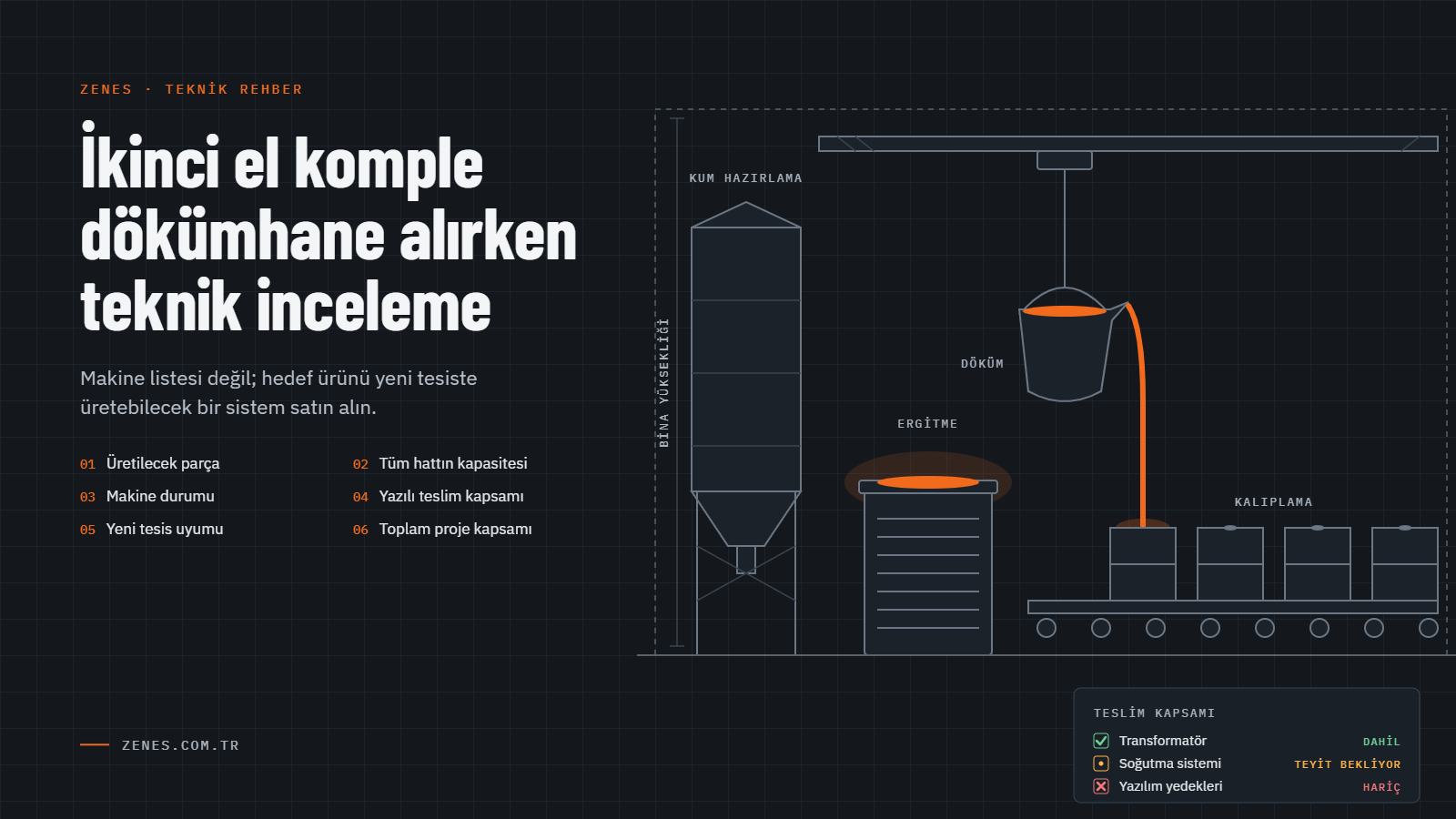
Buying a complete used foundry means more than purchasing an equipment list. The key question is whether the available machinery can produce the intended castings under the conditions of the new site. Before committing to a purchase, a technical assessment should therefore consider equipment condition, production flow, supply scope and reinstallation requirements together.
1. DEFINE THE CASTINGS FIRST
Start with the products, not the machinery brand. Establish the metal grades, casting weights and dimensions, core requirements, quality expectations and monthly production target. Assess the choice of green sand, chemically bonded sand or another moulding process against these requirements.
A plant that produced successfully for its previous owner is not automatically suitable for a different product range.
2. ASSESS CAPACITY ACROSS THE WHOLE LINE
Review melting, sand preparation, moulding, coremaking, pouring, cooling and cleaning within the same production plan. Do not treat furnace capacity and the quantity of saleable castings as interchangeable figures.
Request historical production records and clarify the products, shift patterns and operating conditions behind them. Where feasible, arrange a production trial before dismantling, with the test conditions agreed in writing.
3. DOCUMENT EQUIPMENT CONDITION
Record the model, serial number, current condition, maintenance history and missing components for each machine. The inspection checklist may include sand mixer wear parts, conveying equipment, hydraulic systems, electrical cabinets and automation components.
Guards, safety devices and operating instructions deserve separate review. The fact that used machinery runs does not establish that it is ready for safe operation. Competent personnel should carry out inspections and tests. Technical safety reference: HSE
4. DEFINE “COMPLETE PLANT” IN WRITING
Clarify which auxiliary items accompany the main machines. Check the transformer, cooling system, compressor, filters, piping, cables, platforms, laboratory equipment, spare parts and software backups as separate entries.
Mark every item as “included”, “excluded” or “awaiting confirmation”. Equipment appearing in a photograph does not, by itself, confirm its inclusion in the sale.
5. CHECK THE NEW SITE BEFORE PURCHASE
Assess compatibility with building height, available floor space, foundation requirements, utilities, transport routes and maintenance access. Assign responsibility for dismantling, identification, packing, transport and reassembly.
Equipment reassembled at another location should be checked before being put into service. Its operating condition at the old site does not, by itself, verify the new installation. Technical inspection reference: HSE
6. BASE THE DECISION ON THE TOTAL PROJECT SCOPE
Assess refurbishment, missing equipment, transport, site infrastructure, installation, commissioning and training separately from the purchase price. Define the acceptance trial’s product, duration, measured outcomes and responsibilities in the contract.
ZENES evaluates new and used machinery, complete plant opportunities and, where necessary, supplementary equipment from different manufacturers according to project requirements. The quotation defines the scope of technical assessment, procurement coordination, dismantling, installation and after-sales services.
A sound used-equipment investment depends not only on an attractive purchase price, but on clarity about what is being bought and what is required to start production.
Call to action
Send ZENES the equipment list, current photographs and target products for the plant you are considering. Let us assess its technical inspection and reinstallation requirements together.